Our Methods
Reef Buddy Philippines runs all of its reef monitoring work to internationally standardised scientific protocols. We do not use proprietary methods. Every survey our volunteers contribute to follows procedures used in peer-reviewed marine research, which means our data is comparable across sites, across years, and against any reef being monitored to the same standards anywhere in the world. This page sets out exactly what those methods are and how we apply them in Dauin.
Why methodology matters
The quality of reef monitoring data depends entirely on the methodology used to collect it. Two volunteer programmes can count the same fish on the same reef and produce data that cannot be compared, because their protocols differ in what they count, how they count it, and at what depth and distance.
Standardised methodology solves this. When every surveyor uses the same indicator species lists, the same transect dimensions, the same depth bands, and the same identification training, data becomes meaningful at scale. A reef in Dauin can be compared to a reef in the Maldives, the Caribbean, or the Great Barrier Reef. Trends across decades can be tracked. Changes can be attributed to specific pressures rather than to changes in who was holding the slate.
For marine science students and supervisors evaluating a field placement, methodology is the first thing to check. We have built Reef Buddy Philippines around protocols that hold up to that scrutiny.
Reef Check Protocols
Reef Check is the global standard for citizen-science coral reef monitoring. Developed in 1996 and now operating in over 90 countries, the methodology produces data that contributes to peer-reviewed research, government marine protected area management, and reports to UN agencies including UNEP. We follow the Reef Check EcoDiver Indo-Pacific protocol exactly as published by Reef Check Foundation.
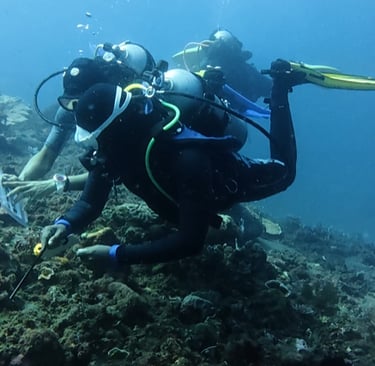
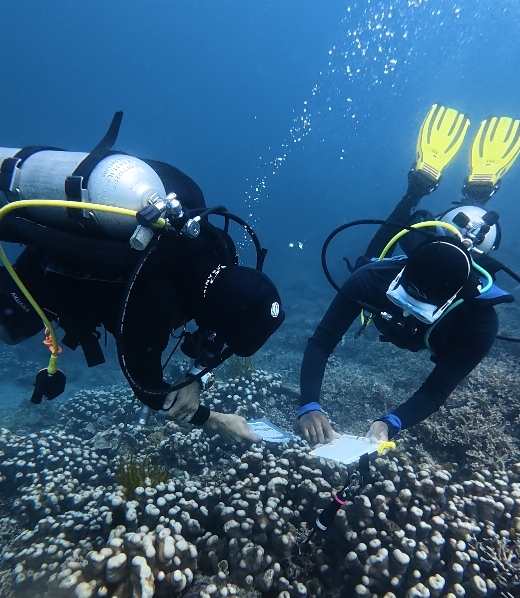
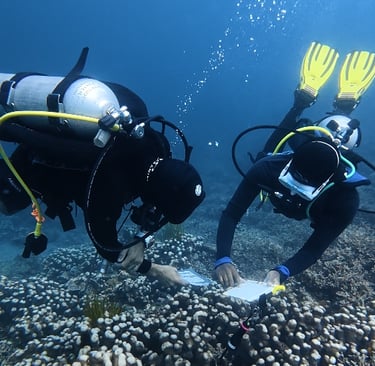
A Reef Check survey covers three components — fish, invertebrates, and substrate — surveyed along four 20-metre belt transects at each of two depth bands: shallow (2–6 metres) and deep (6–12 metres). Eight transects per site, run by surveyors working in pairs and recording on underwater slates.
Invertebrate indicator survey
The invertebrate survey runs along the same transects but focuses on species that signal either ecosystem health or human pressure. Volunteers search 2.5m either side of the line, looking under ledges and into crevices.
Indo-Pacific indicators include:
Banded coral shrimp — collected for the aquarium trade
Diadema urchins — population control signal; high numbers suggest overfishing of predators
Pencil urchins — collected for the ornament trade
Collector urchins — overharvested for food in some areas
Sea cucumbers (edible species including pinkfish, prickly redfish, and greenfish) — heavily fished for export
Tritons — predators of crown-of-thorns starfish; collected for their shells
Lobsters — fishing pressure indicator
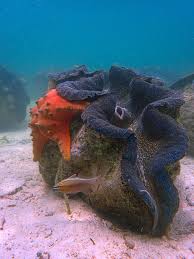
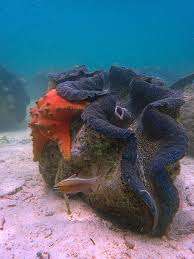
Giant clams — collected for meat and shell trade
Crown-of-thorns starfish — outbreak indicator; consumes live coral
Fish indicator survey
Reef Check counts a defined list of indicator fish species, not every fish on the reef. The list is chosen to capture species that signal fishing pressure, ecosystem health, and recovery from damage. Volunteers swim each 20m transect at a controlled pace, recording every indicator fish observed within 2.5m either side of the line and up to 5m above it.
Indo-Pacific indicator species include:
Butterflyfish (all species) — sensitive to coral cover changes; an early indicator of reef stress
Sweetlips (all species) — targeted by spearfishers
Snapper (all species, any size) — primary fishing pressure indicator
Barramundi cod — IUCN-listed, fishing pressure indicator
Humphead wrasse — IUCN-listed, highly targeted
Bumphead parrotfish — IUCN-listed, vulnerable to night spearfishing
Parrotfish (greater than 20cm) — herbivore essential to coral recovery
Moray eel — predator indicator
Grouper (greater than 30cm) — high-value fishing target
The size threshold applies specifically to grouper and parrotfish. All other species are counted regardless of size. This precision matters: incorrect application of size rules produces data that cannot be submitted to the global Reef Check database.
Substrate survey
The substrate survey uses a point intercept method along the same transects. Every 50cm along the 20m line, surveyors record what lies directly beneath the tape, producing 40 data points per transect. Categories include:
Hard coral
Soft coral
Recently killed coral
Nutrient indicator algae
Sponge
Rock
Rubble
Sand
Silt
Other
The percentages produced by these point counts give a quantitative measure of reef condition. Repeated over time, they show whether coral cover is recovering, declining, or being replaced by algae — a key signal of nutrient pollution and ecosystem shift.
CoralWatch coral health monitoring
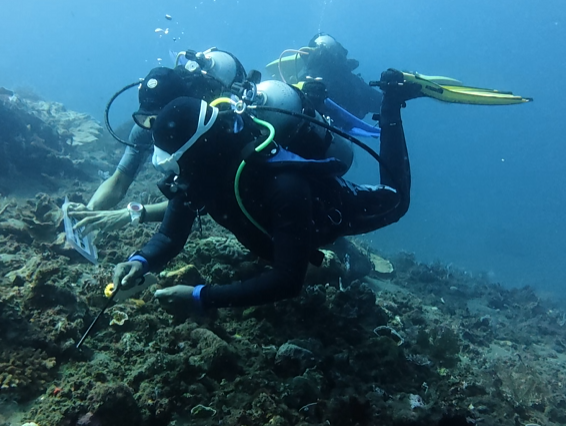
CoralWatch is a complementary methodology developed at the University of Queensland that allows volunteers to monitor coral bleaching using a standardised colour chart. A diver compares the colour of a coral against the chart and records both the lightest and darkest colours present. Repeated surveys of the same colonies allow bleaching events to be tracked over time and recovery to be measured.
The CoralWatch dataset is global and freely accessible to researchers. It complements Reef Check substrate data by tracking the condition of living coral — not just its presence or absence — and provides early warning of bleaching events before they become catastrophic.


BRUVS apex predator monitoring
Baited Remote Underwater Video Systems (BRUVS) are camera rigs deployed on the seabed to record apex predator activity without divers in the water. The standard BRUVS rig consists of a stabilised frame, a bait arm extending forward, a sealed bait canister of crushed oily fish such as scad or sardine, and a video camera recording for 60 to 90 minutes per deployment.
We deploy BRUVS at sites across Dauin's waters, in habitats ranging from sand flats adjacent to reef edges to deeper coral slope. Footage is reviewed frame by frame in the analysis room to identify every fish species visible, the maximum number of individuals of each species seen simultaneously (the MaxN metric, the standard measure for BRUVS surveys), and behavioural notes including any bite events at the bait.
Species of particular interest for Dauin BRUVS work include thresher sharks (Alopias pelagicus), blacktip reef sharks (Carcharhinus melanopterus), and eagle rays — large predators reported locally but rarely seen on standard reef surveys. BRUVS captures species that flee from divers, surveys them quantitatively, and produces video evidence that backs up the data. Most volunteer programmes do not run BRUVS at all; we have built it into our protocols because the data on apex predators is otherwise nearly impossible to collect at this scale.
3D photogrammetry reef mapping
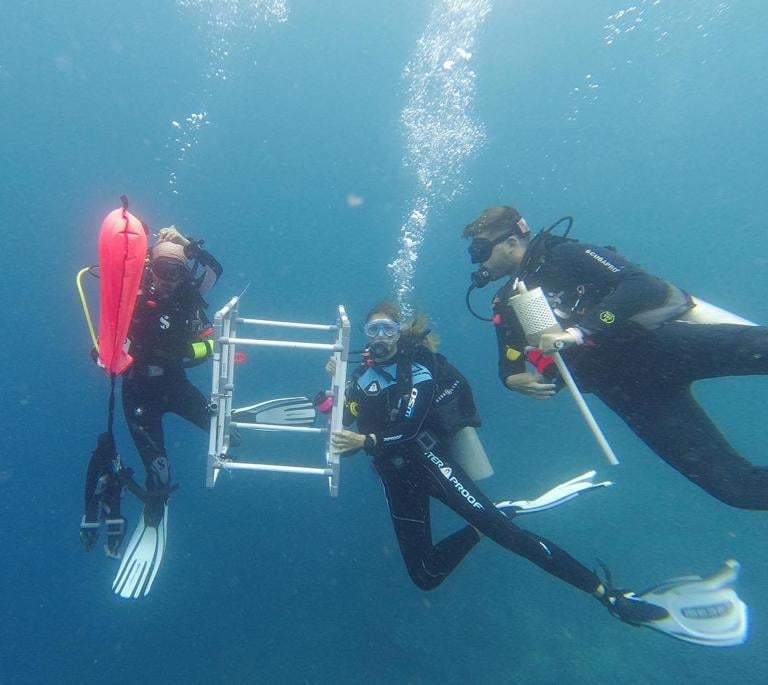
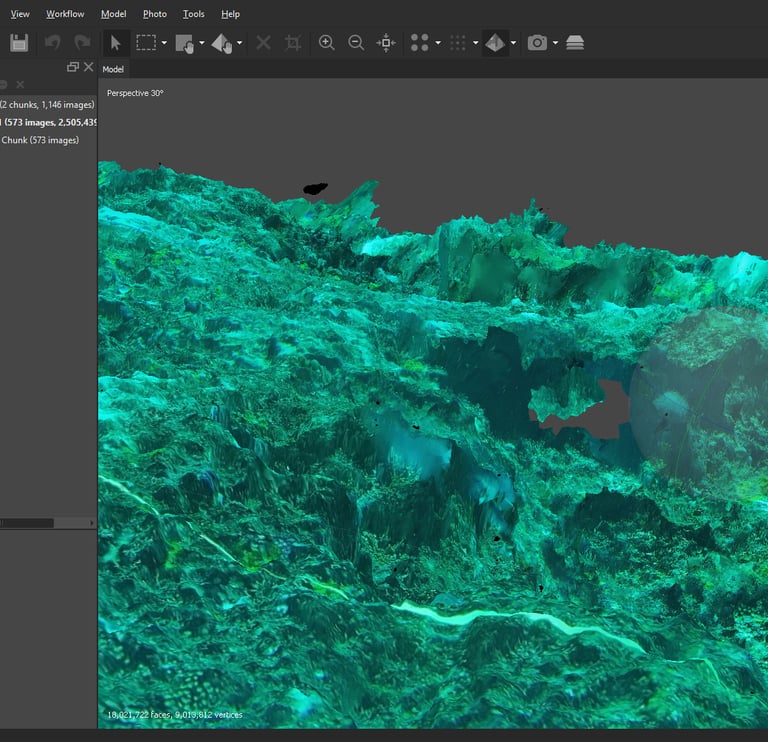
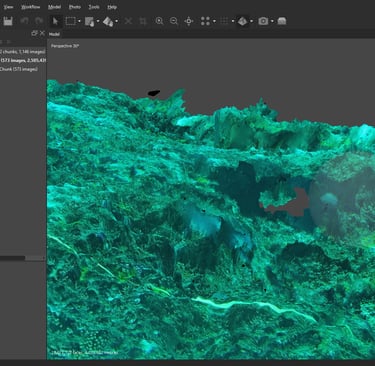
3D photogrammetry creates centimetre-accurate three-dimensional models of reef structures from sequences of overlapping photographs. A diver swims a pre-planned grid pattern over a defined reef area, taking several hundred high-overlap photographs from multiple angles and depths. The images are processed in Agisoft Metashape software to reconstruct a full 3D surface model of the reef section.
The output is a digital twin of the reef that can be measured, compared against past models, and used to track changes in structural complexity over time. Structural complexity matters because reef value as fish habitat depends on three-dimensional architecture, not just coral cover — a reef with complex structure supports far more fish biomass than a flatter reef with the same coral percentage, even when the simpler reef looks healthier on standard surveys.
Reef Buddy Philippines is currently piloting photogrammetric mapping at our primary monitoring sites in Dauin. The aim is a repeat-survey baseline that will let us track structural recovery (or loss) of specific reef sections over years, not just months.
Where our data goes
Reef Buddy Philippines builds long-term reef baselines for monitoring sites in Dauin's waters. Every survey we run is logged, archived, and used to track change over time at our specific study sites.
Reef Check survey data is collected to Reef Check Foundation's published protocols. As our team completes its training pathway to Reef Check EcoDiver Instructor status — expected later in 2026 — survey data is held internally with the intention of submission to the global Reef Check database once we are formally certified to do so. CoralWatch data is submitted directly to the CoralWatch global database. BRUVS footage and analysis form part of our internal research outputs and are available to local government units and academic partners on request.
The point is not where the data is stored today. The point is that it is collected to standards that will hold up to external scientific scrutiny.
Who delivers the training
Survey training is delivered by qualified PADI dive professionals with marine ecology backgrounds, working in partnership with The Dive Hub Dauin (PADI 5-Star facility). Reef Check protocol training follows Reef Check Foundation standards, with our team having completed EcoDiver certification under a visiting Reef Check trainer in May 2026 and progressing to Reef Check Instructor qualification through the second half of 2026.
Tom Anderson, Programme Coordinator, holds PADI Master Scuba Diver Trainer certification (#534733). His background combines a decade of classroom teaching experience with active coral restoration field work — most recently running a coral frame restoration programme at a Maldives resort operation. The teaching foundation matters on a methodology-focused programme: protocols only get followed properly if the trainer can explain them clearly to international volunteers from a wide range of backgrounds. The wider Reef Buddy team brings combined experience across the Caribbean operation — founded in 2014 in Grenada and named Most Dedicated Marine Conservation Organisation 2023 by Acquisition International — and the Philippines launch.
Volunteer training begins on arrival and continues throughout each placement. No volunteer participates in survey dives until buoyancy assessments are signed off — a Reef Check requirement we treat as a feature, not a barrier. Data quality starts with diver quality.
Questions about our methodology
We're happy to provide further detail on any aspect of our protocols, share copies of the Reef Check methodology documentation, or arrange a call with our programme team for university supervisors evaluating placement options. Email info@reefbuddyphilippines.org with any questions..
Phone/WhatsApp
+63 917-779-8761
Info@reefbuddyphilippines.org